
Establishing a competitive sanitaryware manufacturing facility requires systematic strategic planning and comprehensive techno-economic analysis. This article outlines the critical factors that must be evaluated from an investment decision-making perspective.
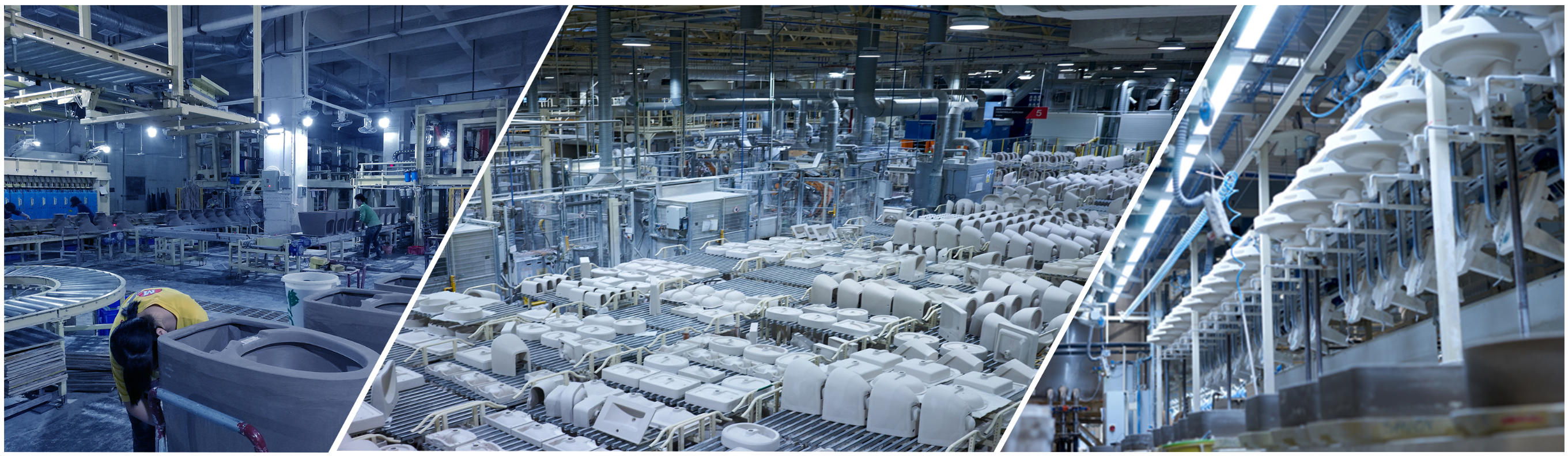
I. Capacity Planning and Economies of Scale
Determining production capacity is the primary factor influencing project economics. An undersized scale leads to high unit costs and weak market competitiveness. Industry experience suggests that the planned daily output for a new plant should not fall below 500 pieces of standard sanitaryware products (e.g., toilets, basins) as a fundamental threshold for achieving break-even and operational profitability.
The logic of economies of scale lies in the amortization of fixed costs. Overheads such as management, utilities, and infrastructure depreciation are relatively inflexible. As production volume increases, the fixed cost allocated per unit decreases significantly, yielding significant contribution to marginal profit. Therefore, a rigorous assessment of the alignment between target market size and planned capacity is essential in the investment feasibility study.
II. Technology Selection and Automation Strategy
Equipment selection and the degree of automation directly impact initial investment, operational costs, and long-term competitiveness. The goal is not maximal automation, but rather identifying the most appropriate technological path based on local conditions (e.g., labor costs, capital availability).
Capital-Intensive Strategy: Suitable for regions with high labor costs and abundant capital. This approach heavily utilizes high-pressure casting machines, automated glazing robots, and smart warehousing/logistics systems. It requires substantial initial investment but offers benefits in quality stability and reduced reliance on manual labor over the long term.
Labor-Intensive Strategy: In areas with ample and cost-effective labor resources, retaining manual operations for certain critical stations (e.g., fettling complex shapes, inspection) can be more cost-efficient. Investment here should focus on core equipment that ensures baseline quality and efficiency.
III. Plant Location and Supply Chain Configuration
The site selection decision must weigh multiple factors:
Proximity to Raw Materials: Bulk materials like kaolin, ball clay, and feldspar incur significant logistics costs; being near mining areas helps control these expenses.
Accessible Transportation Network: Proximity to main roads, ports, or railways facilitates the efficient distribution of finished goods to target markets.
Local Industrial Support: The availability of local supporting services, such as mold manufacturing, refractory supply, and equipment maintenance.
Regulatory Compliance & Permits: Understanding local policies on industrial land, tax incentives, environmental emission standards, and securing necessary approvals in advance.
IV. Product Strategy and Model Development
A clear product positioning and model plan form the foundation of plant operations.
Market Orientation: Initially, it is advisable to focus on a few core categories (e.g., close-coupled toilets, pedestal basins, urinals) to build competitive flagship products, rather than pursuing an extensive model range.
Development Routes: Product models can be developed in-house or licensed from specialized model studios. The former is time-consuming and costly but enables differentiation; the latter allows for quicker market entry but carries a higher risk of product homogenization.
Concurrent Engineering: Model development, process testing, and factory construction should proceed in parallel to shorten the overall project timeline.
V. Project Timeline and Key Milestones
The journey from project initiation to stable mass production typically requires 12 to 18 months. A structured project plan should include these key phases:
Feasibility Study & Final Investment Decision (1-2 months)
Plant Design & Core Equipment Procurement (3-4 months)
Civil Works & Utility Installation (4-6 months)
Equipment Installation, Commissioning & Process Trials (2-3 months)
Trial Production & Capacity Ramp-up (2-3 months)
Mass Production & Market Launch
VI. Core Resources and Professional Support
Establishing a sanitaryware plant necessitates external expertise.
Technical Consultants: Responsible for core tasks like body and glaze formulation development, kiln curve setting, and production process design.
Legal & Financial Advisors:Assist with company registration, land acquisition, environmental permits, tax planning, etc.
Market & Sales Team: It is recommended to initiate brand building and channel development before the plant is operational, facilitating for product sales once mass production begins.
Systematic planning is the cornerstone of mitigating investment risks and ensuring project success. A detailed business plan and a viable technical implementation plan are indispensable before commencing construction.