The Battery Casting Machine represents a significant advancement in the Forming Process of Sanitaryware, particularly when compared to traditional Bench Casting technology. By arranging numerous Molds in an array format, it achieves a substantial increase in Productivity while dramatically reducing the required Production Space.
Many Sanitaryware manufacturers are actively upgrading their conventional Bench Casting lines to Battery Casting Machines, especially for standardized items like Water Closets, Washbasins, and Pans. This investment typically shows a rapid return, with a payback period estimated around one year.
Core Process and Operating Mechanism
Battery Casting follows the fundamental principles of Slip Casting, but incorporates mechanization and automation into the Mold and Slip handling.
1. Structural Design and Mold System
The essence of the Battery Casting Machine lies in its compact arrangement and its user-friendly transport system.
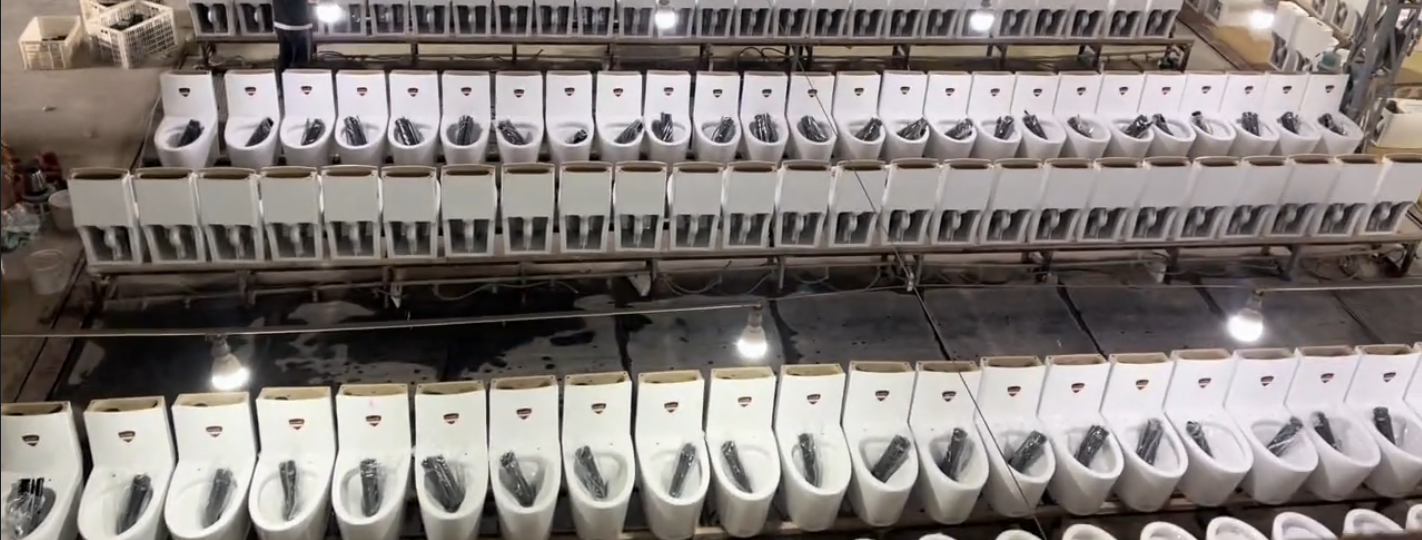
Array Arrangement: Molds are arranged closely together, "like batteries," accommodating a much higher quantity of Molds.
Support and Movement: Molds are placed on Mold Carriers equipped with bearings, which enable the smooth sliding and easy Handling of Molds along tracks.
Main Components (Expansion): The machine comprises key elements such as the Mold Clamping Device, Guide Pins with bearings, trolleys, Slip pipelines (e.g., PVC Slip Line and main valves), and the Slip Tank with its stand.
2. Casting and Drainage Differentiation
The primary difference from traditional Bench Casting is evident in the Slip Drainage phase:
Accelerated Drainage: In the Battery Casting Machine, Slip Drainage is assisted by air pressure, which significantly speeds up the Draining process.
Gravity Limitation: Conventional Bench Casting relies solely on gravity for Slip Drainage, leading to lower efficiency.
Slip Requirements: Unlike some High-Pressure Casting systems, this machine does not require a specially formulated Casting Slip; standard Bench Casting Slip can be utilized.
Three Key Advantages of the Battery Casting Machine
Due to its structural advantages, the Battery Casting Machine offers transformative benefits to Sanitaryware manufacturing:
Doubled Productivity: Compared to traditional Bench Casting methods, its Productivity is nearly doubled. For instance, one line can hold up to 60 large Washbasin Molds or 40 Water Closet Molds.
Space Efficiency: The machine requires very little Space, a critical factor for modern factories facing high land costs.
Quality and Safety Enhancement:
Ease of Operation: Mold Handling is made easy by sliding the Molds along the rail without the need for heavy lifting.
Minimized Damage: The possibility of Mold breakage and Chipping—a frequent issue in Bench Casting—is greatly minimized.
Multiple Part Casting: For smaller accessory products like P or S Traps, a single Mold can produce more than one Green Body.
Scope of Application and Technical Limitations
The applicability of the Battery Casting Machine is primarily constrained by the complexity of the product Geometry:
Suitable Products: The equipment is best suited for relatively simple Sanitaryware products such as Washbasins, Water Closets, and Traps.
Limitations: It is much more difficult or unsuitable for producing complex patterns like One-Piece Toilets or Urinals.
Conversion Requirement: Switching from Bench Casting to Battery Casting necessitates certain Design Changes to the existing Molds.
Conclusion: Advancing to High-Efficiency Casting
The Battery Casting Machine embodies the trend towards high-efficiency in Sanitaryware Forming Process, offering businesses lower Space requirements and higher Productivity. It semi-automates the Mold Handling from Slip filling to Demolding and is a critical step in the modernization of Sanitaryware manufacturing.