The successful establishment of any new sanitaryware manufacturing facility necessitates a thoroughly researched strategic budget. Long-term market competitiveness and financial viability hinge upon achieving the dual objectives of maintaining high product quality standards and ensuring a low Production Cost. Investment planning must strategically address the following critical factors for erection.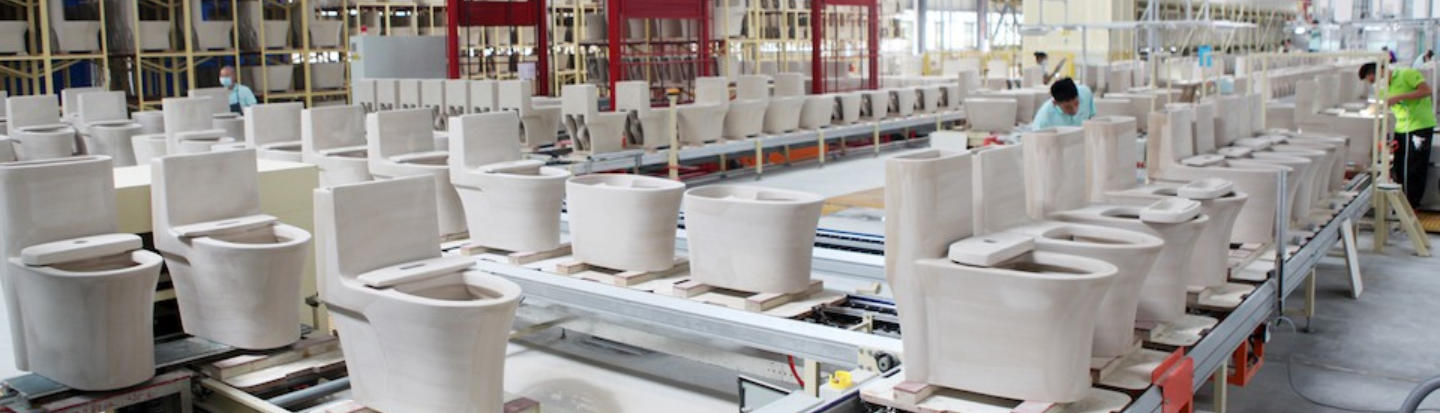
I. Core Capacity and Firing Infrastructure
The configuration of the Kiln represents one of the largest fixed capital investments, requiring synchronization with planned capacity and future Expansion Requirements.
Kiln Selection Strategy:
For initial or pilot Production capacities below 600 pieces per day, the primary recommendation is to install a shuttle kiln.
If current or future capacity exceeds 2,000 pieces per day, it is prudent to first install a shuttle kiln to stabilize Production during the initial year, then proceed with the installation of a tunnel kiln.
A tunnel kiln should only be pursued if stable, high-volume capacity is reliably anticipated. Reputable sanitaryware brands often utilize both Kiln types for flexible management of the Firing process and production downsizing.
Raw Material Recycling and Sustainability: Investment must incorporate sustainable Raw Materials Processing options:
Utilize a Pitcher Machine to crush and reuse rejected products from the process as a raw material, promoting internal recycling and reducing the consumption of new resources.
Implement a sludge kiln to fire and remove organic impurities from sludge. The purified material can then be repurposed into the product Body, ensuring waste minimization and material suitability.
II. Operational Model and Automation Deployment
The chosen Automation Level critically impacts both initial capital outlay and long-term operating costs.
Return on Investment (ROI) Consideration: The cost of automation in the sanitaryware industry is substantial (up to three times manual labor cost). Unless daily capacity is extremely high (above 5,000 pieces) and labor is scarce with low energy costs, a Semi-automation approach is recommended, allowing for gradual integration of further automation to optimize ROI. In regions with high labor availability, a fully manual production setup may minimize initial and operating costs.
Layout and Redundancy: Plant layout must account for future Expansion Requirements by ensuring sufficient space for equipment. Crucially, in the Slip, Glaze, and Casting departments, a minimum of two sets of key machinery should be planned to allocate total capacity, mitigating the impact of unexpected breakdowns on Production.
III. Project Execution and Quality Assurance
Project Execution Model: Factories can be erected via a Turnkey Company or an In-House Team.
A Turnkey Company offers speed and single-point accountability from planning to execution, but at a higher cost with limited flexibility for mid-course plan modification.
An In-House Team provides cost savings (up to 30% by direct procurement) and full managerial control over customization, but requires greater time for planning and execution.
A hybrid approach—leveraging the In-House Team while strategically sourcing parts of the project from external companies—is often the optimal strategy for balancing investment and efficiency.
Quality Control (QC) System Investment: Strategic investment in the infrastructure for a QC System and Defect Analyzing System is vital, as Production Cost is directly dependent on Defect reduction.
This should include investment in software for touch screen Defect Recording System , and, based on factory culture and location, the implementation of a Barcode Tracking System.
Ensure compliance machinery is in place, such as the Air Leak Test Machine for Water Closet leakage testing, the Trap Glaze Machine for Glazing the trapway, and the Rim Glaze Gun for spraying Glaze under the rim.
Conclusion:
The long-term viability of a new sanitaryware factory is secured by strategically allocating the budget to achieve the fundamental goals of high-quality products and low Production Cost.