In an increasingly competitive global sanitaryware market, achieving sustainable cost leadership is paramount. Manufacturers must adopt a systematic approach to reduce production expenses while upholding quality standards, thereby enhancing product value proposition and ensuring substantial profitability across the distribution network. This article outlines ten strategic levers for effective cost management.
1. Systemic Reduction of Process Loss
Controlling process loss forms the foundation of cost management. Losses are primarily categorized as green body rejects and fired ware rejects. The latter represents a total loss, incurring material, energy, and disposal costs. Implementing robust process control to identify and scrap defective pieces at the green stage is crucial, as the body material can then be recycled, salvaging most of the raw material value.
2. Strategic Automation and Smart Upgrades
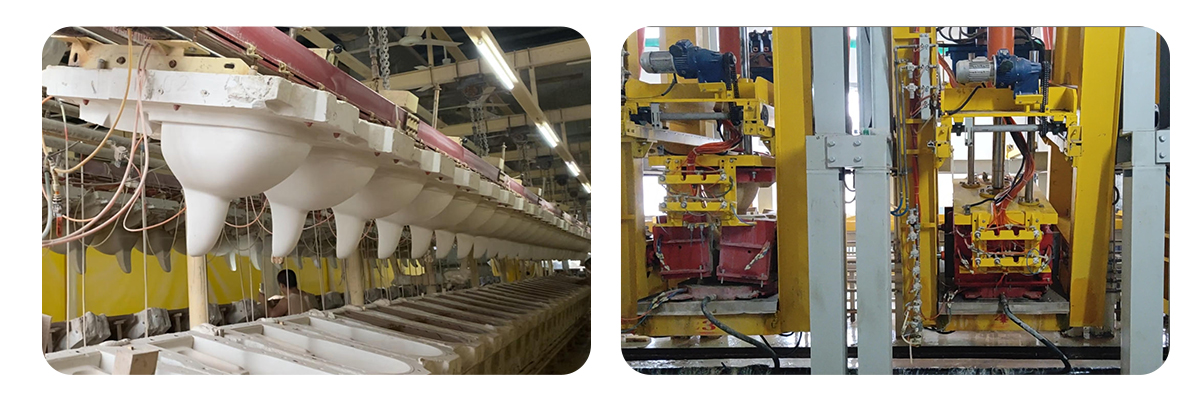
Automation strategy should be tailored to regional labor costs. In high-wage regions, integrating advanced equipment like high-pressure casting machines, automated glazing robots, and monorail conveyor systems significantly reduces direct labor, optimizes floor space, and improves production rate. Automated batching systems in body and glaze preparation ensure formulation consistency, minimizing quality variations from the source.
3. Product Lightweighting Engineering
Structural optimization for weight reduction is a powerful cost lever. Utilizing digital design tools to analyze wall thickness distribution allows for the minimization of material in non-critical areas and the elimination of redundant structures without compromising structural strength. Successful lightweighting can achieve approximately 10% weight reduction, concurrently lowering material consumption, firing energy, and logistics expenses.
4. Optimization of Overall Equipment Effectiveness
Maximizing the utilization of critical equipment is central to reducing per-unit cost. For instance, optimizing the production schedule, minimizing mold changeover times, and enhancing preventive maintenance for high-pressure casting machines can push daily output towards design capacity. This principle applies universally to kilns, dryers, and robotic workstations.
5. Deepening Process Re-engineering
Continuous process innovation yields significant benefits. Key initiatives include: transitioning from bench casting to battery casting systems; optimizing kiln car loading patterns to improve energy efficiency per unit fired; establishing comprehensive quality control points to minimize specification deviations; and adopting lean inventory practices to reduce working capital.
6. Leveraging Economies of Scale
Increasing production volume effectively amortizes fixed costs. Expenses related to management, infrastructure, and utilities remain relatively stable; thus, higher output spreads these costs over more units, reducing the fixed cost burden per piece and strengthening overall cost competitiveness.
7. Building a Comprehensive Quality Defense Line
Shifting the quality focus upstream is essential. By preventing defects at stages like casting and drying, manufacturers can avoid the irreversible losses associated with firing faulty ware. Enhancing operator skills and quality awareness, coupled with establishing rapid quality feedback and correction loops for quality issues, minimizes the need for rework and its associated additional labor and material costs.
8. Strategic Raw Material Management
Raw material strategy must balance cost and performance. On one hand, introducing more consistent/purer grades of raw materials can optimize total cost by enhancing process stability and product yield. On the other hand, proactively seeking lower-cost alternative materials that do not adversely affect critical product properties directly reduces material procurement costs.
9. Implementing a Lean Talent Strategy
Cost control focuses on optimizing human resource allocation, not merely reducing headcount. Retaining and motivating core technical staff is vital. Their expertise in process optimization, problem-solving, and training delivers value far exceeding their labor expenditure, forming a robust foundation for sustained cost reduction.
10. Establishing a Preventive Maintenance Regime
Implementing a data-driven preventive maintenance schedule for critical equipment like kilns and glazing robots, along with maintaining a strategic stock of spare parts, is imperative. This prevents unplanned downtime and the consequent large-scale quality defects, which cause production costs to spike unexpectedly, ensuring stable operation and cost control.